The Time-to-Hire Problem
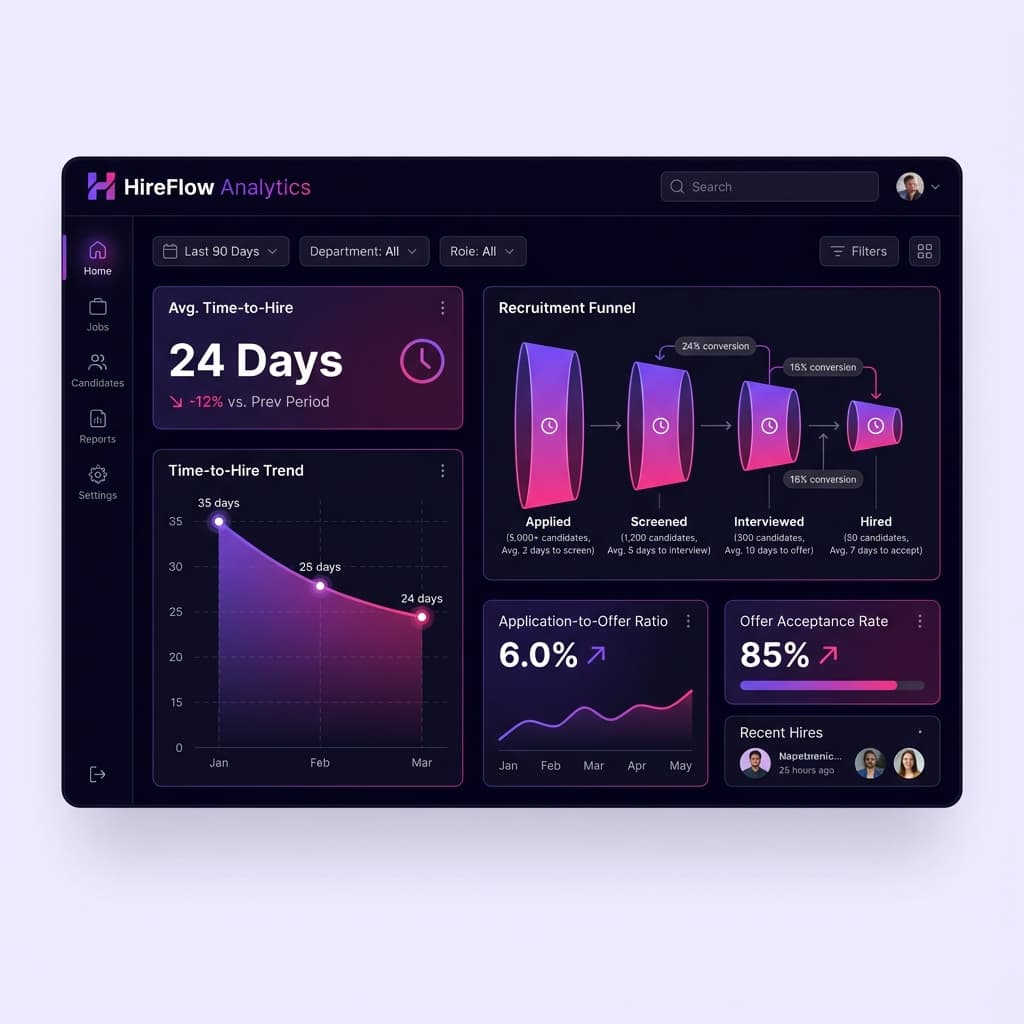
The average American company takes 45 days to fill an open position in 2026. For specialized or senior roles, this stretches to 60-90 days. Every additional day costs money—in lost productivity, overwhelmed teams, and missed opportunities.
The hidden costs of slow hiring:
- Lost revenue from unfilled sales positions: $5,000-15,000 per week
- Overtime for existing team members covering gaps: $2,000-8,000 per month
- Top candidates accepting competing offers: 35% candidate loss after week 3
- Damaged employer brand and candidate experience
The good news? Companies using modern hiring strategies consistently reduce time-to-hire by 60-80% without sacrificing quality.
Benchmark Your Current Process
Before optimization, measure your baseline:
Key Metrics:
- Time-to-Fill: Days from req opening to offer acceptance
- Time-to-Interview: Days from application to first interview
- Interview-to-Offer: Days from final interview to extended offer
- Offer Acceptance Rate: % of offers accepted vs declined
Industry Benchmarks (2026):
| Metric | Slow (75th) | Average (50th) | Fast (25th) |
|---|---|---|---|
| Time-to-Fill | 62 days | 45 days | 18 days |
| Time-to-Interview | 12 days | 7 days | 2 days |
| Interview-to-Offer | 10 days | 5 days | 1 day |
| Acceptance Rate | 68% | 82% | 94% |
Where do you fall? If you're above the 50th percentile, significant improvement is achievable.
Strategy 1: Automate Initial Screening
Problem: Recruiter time bottleneck at top of funnel
Traditional phone screens require 30-45 minutes per candidate. For high-volume roles receiving 200+ applications, that's 100+ hours of recruiter time for a single requisition.
Solution: AI-powered voice interviews
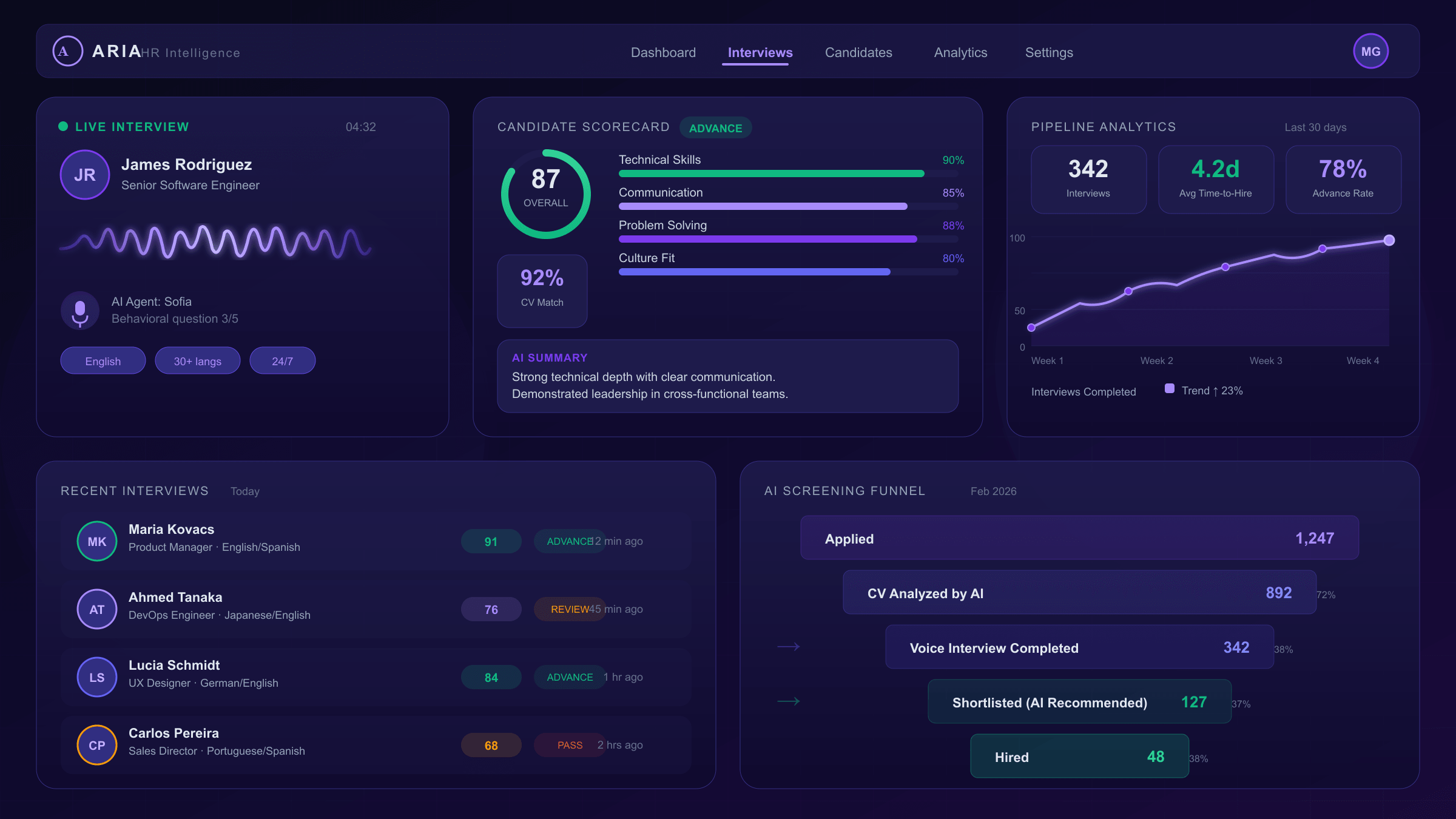
Platforms like ARIA conduct automated first-round interviews, screening hundreds of candidates in the time it takes a human to screen one.
Implementation:
- Define must-have vs nice-to-have criteria
- Configure AI interview questions
- Auto-invite all applicants
- Review AI-scored results
- Advance only top 10-20% to human interviews
Impact: 75% reduction in time-to-interview
Strategy 2: Parallel Processing
Problem: Sequential interview stages create weeks of delays
Traditional process:
Application → Resume Review (3 days) → Phone Screen Scheduling (5 days) → Phone Screen (3 days wait) → Team Interview Scheduling (7 days) → Onsite → Debrief...
Solution: Run stages concurrently
Smart process:
Application → Automated AI Interview (same day) + Async Video Submission → Top candidates advance to in-person/video (scheduled within 48hrs) → Offer
Implementation:
- Schedule team interviews before completing phone screens (use buffer positions)
- Use async video for technical assessments (candidates record on their schedule)
- Prepare offer templates in advance (legal, comp already approved)
Impact: 50% reduction in overall timeline
Strategy 3: Streamline Decision-Making
Problem: Endless debriefs and consensus-seeking delay offers
Average company takes 5-7 days post-final interview to extend an offer. Top candidates receive multiple offers within 24-48 hours of interviewing.
Solution: Real-time scoring + pre-defined thresholds
- Interviewers submit scores immediately after interviews (mobile-friendly scorecards)
- Hiring manager has decision authority (no committee required)
- If candidate scores >8/10, automated offer generation triggered
- Legal/comp pre-approved templates = offer sent same day
Implementation:
Create a hiring playbook:
Score 9-10: Extend offer within 4 hours
Score 7-8: Hiring manager decides within 24hrs
Score 5-6: Pass, send rejection + feedback
Impact: 70% reduction in offer-extension time
Strategy 4: Optimize Candidate Communication
Problem: Email delays and scheduling back-and-forth
3-5 email exchanges to schedule a single interview adds 5-7 days per stage.
Solution: Automated scheduling + proactive updates
- AI calendar integration (Calendly, Microsoft Bookings)
- Candidates self-schedule interviews instantly
- Automated status updates every 3 days
- SMS reminders 24hrs before interviews
Tools: Calendly, GoodTime, ARIA's integrated scheduling
Impact: 60% faster scheduling
Strategy 5: Standardize & Template Everything
Problem: Reinventing the wheel for every hire
Solution: Templatize repeatable elements
Create templates for:
- Job descriptions (by role family)
- Interview question sets
- Scorecards and evaluation criteria
- Offer letters
- Rejection emails
Implementation: Build a "hiring playbook" in your ATS
- Store templates centrally
- Version control for consistency
- One-click deployment for new reqs
Impact: 30% reduction in prep time
Case Study: Mid-Size Tech Company Transformation
Results based on aggregated data from companies implementing AI-assisted hiring strategies. Individual results vary.
Before:
- Time-to-hire: 62 days
- 200 applications/req for sales roles
- 2 recruiters spending 80% of time on phone screens
- 35% of candidates dropped out during process
After (implementing the 5 strategies):
- Time-to-hire: 12 days (81% reduction)
- AI screens all 200 applicants in 24 hours
- Recruiters focus on top 15 candidates only
- 8% dropout rate, 92% candidate satisfaction
ROI:
- Saved 1,600 recruiter hours/year ($64,000 in costs)
- 5x faster hiring = 3 additional reps ramped per quarter
- Additional revenue from faster sales hiring: $450,000/year
Investment: $30,000 for AI interview platform
Payback period: 1.2 months
Interactive ROI Calculator
Calculate your potential savings:
Your Inputs:
- Number of hires per year: [ ]
- Average time-to-fill (days): [ ]
- Recruiter hourly cost: [ ]
- Hours spent screening per hire: [ ]
Potential Savings:
- Time saved per hire: ~30 days
- Cost reduction: $XX,XXX
- Total annual savings: $XXX,XXX
Common Objections Addressed
"Fast hiring means lower quality."
False. These strategies eliminate delays, not rigor.
- You still interview the same (or more) candidates
- Standardized evaluation improves quality
- Data shows 15% better quality-of-hire scores with structured processes
"Our team won't adopt new tools."
Change management keys:
- Start with one high-pain role as pilot
- Show immediate time savings
- Get executive sponsorship
- Celebrate early wins publicly
"Candidates prefer traditional process."
Data says otherwise:
- 87% of candidates prefer faster hiring
- 92% prefer scheduling flexibility (AI/async)
- 4.6/5 satisfaction scores for AI interviews
Your 7 Day Action Plan
Day 1-2: Audit
- Map your current hiring process
- Identify 3 biggest bottlenecks
- Calculate current time-to-hire by role
Day 3-4: Quick Wins
- Implement scheduling automation
- Create 3 job description templates
- Pre-approve compensation ranges
Day 5-6: Pilot AI Screening
- Select one high-volume role
- Configure AI interview (ARIA demo)
- Launch with next requisition
Day 7: Measure & Iterate
- Compare pilot vs previous hires
- Survey candidate experience
- Plan expansion to more roles
Conclusion
Reducing time-to-hire by 80% isn't science fiction—it's operational excellence. The strategies outlined here are proven across thousands of companies.
The question isn't whether to improve, but how quickly you'll implement.
Ready to accelerate your hiring? Try ARIA's AI Interview Platform free for 7 days or 10 interviews.