Why Inclusive Hiring Matters
Diverse teams outperform homogeneous ones by 35% (McKinsey, 2025). Yet traditional hiring systematically excludes qualified candidates due to:
- Unconscious bias favoring "culture fit" (code for "looks like us")
- Network-driven recruitment (same schools, same companies)
- Biased job descriptions (gendered language, unnecessary requirements)
- Inconsistent evaluation criteria
AI, when implemented thoughtfully, removes these barriers (we explore the underlying data in AI vs Human Recruiters: The Truth About Bias in Hiring).
The 7-Step Inclusive Hiring Framework
Step 1: Audit Your Current State
Measure before improving:
- What % of your pipeline is diverse at each stage?
- Where does drop-off occur (applications → interviews → offers)?
- Do offer acceptance rates vary by demographic?
Tools: Your ATS reports, anonymized demographic data
Step 2: Write Inclusive Job Descriptions
Research shows:
- Masculine-coded language (competitive, dominate) deters women
- "10+ years experience" excludes career-switchers disproportionately
- "Culture fit" often means demographic homogeneity
AI Solution:
Use tools like Textio or ARIA's JD analyzer to:
- Flag gendered/biased language
- Suggest neutral alternatives
- Remove unnecessary requirements
- Emphasize actual job tasks
Example transformation:
❌ Before: "Seeking a rockstar developer who can dominate our competitive market"
✅ After: "Seeking a skilled developer to build innovative solutions for our growing market"
Step 3: Expand Sourcing Channels
Problem: Relying on employee referrals creates homogeneous pipelines (people refer people like them)
Inclusive sourcing:
- Partner with diversity-focused organizations (AfroTech, Women Who Code, Out in Tech)
- Post on niche job boards (DiversityJobs, Fairygodboss)
- Attend HBCU and women's college career fairs
- Use AI sourcing tools that find candidates by skills, not pedigree
Impact: 40-60% increase in diverse applicant pools
Step 4: Implement Blind Initial Screening
What to hide:
- Name
- Photo
- Gender pronouns
- Age/graduation year
- University name (in some contexts)
AI advantage: Can programmatically remove identifying information while humans struggle to "unsee"
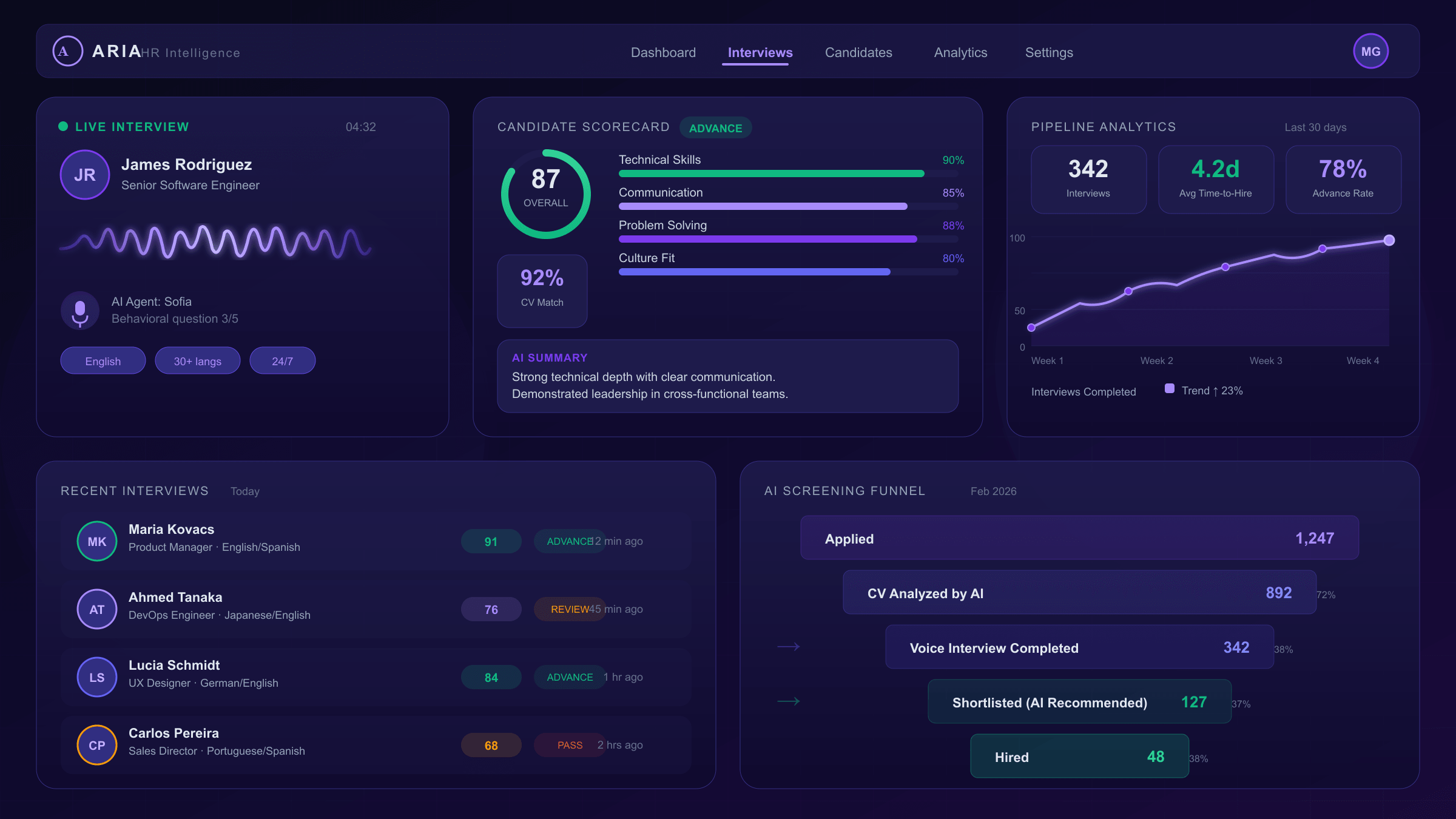
ARIA's approach: Audio-only AI interviews scored against a job-specific rubric — no facial analysis, no emotion inference
Step 5: Standardize Interviews
The problem with unstructured interviews:
Different questions, different difficulty, different evaluation → massive bias
Structured interview checklist:
- ✅ Same questions for all candidates (role-specific)
- ✅ Pre-defined scoring rubric (0-5 scale per criterion)
- ✅ behavioral + situational questions (not hypotheticals)
- ✅ Panel interviews with diverse interviewers
- ✅ Separate scoring before group discussion
AI Enhancement: Perfect consistency—voice AI asks identical questions with identical delivery every time
Step 6: Train Your Team
Even with great systems, humans need education:
Required training:
- Unconscious bias recognition (annual refresher)
- Inclusive language and question-asking
- How to interpret AI recommendations
- Legal compliance (EEOC, affirmative action)
Case studies: Share examples of bias caught and corrected
Step 7: Measure & Iterate
Ongoing monitoring:
| Metric | Target | Frequency |
|---|---|---|
| Application diversity vs local population | Within 10% | Quarterly |
| Pass-through rates by demographic (screen → interview → offer) | Equivalent | Monthly |
| Offer acceptance by demographic | >85% all groups | Quarterly |
| 90-day retention by demographic | Equivalent | Quarterly |
Red flags:
- Diverse application pool but homogeneous hires → interview/evaluation bias
- High application diversity, low offer acceptance → candidate experience issues
- Low application diversity → sourcing/job description problem
Real-World Example: Financial Technology Company
Results based on aggregated outcomes from companies implementing AI-assisted inclusive hiring. Individual results vary.
Baseline (Before inclusive AI hiring):
- 18% women in engineering
- 12% underrepresented minorities
- $2M spent on DEI initiatives with minimal movement
Implementation:
- Rewrote job descriptions with AI analyzer
- Deployed ARIA's blind AI screening
- Trained interviewers on structured evaluation
- Expanded to 12 diversity-focused job boards
Results (12 months):
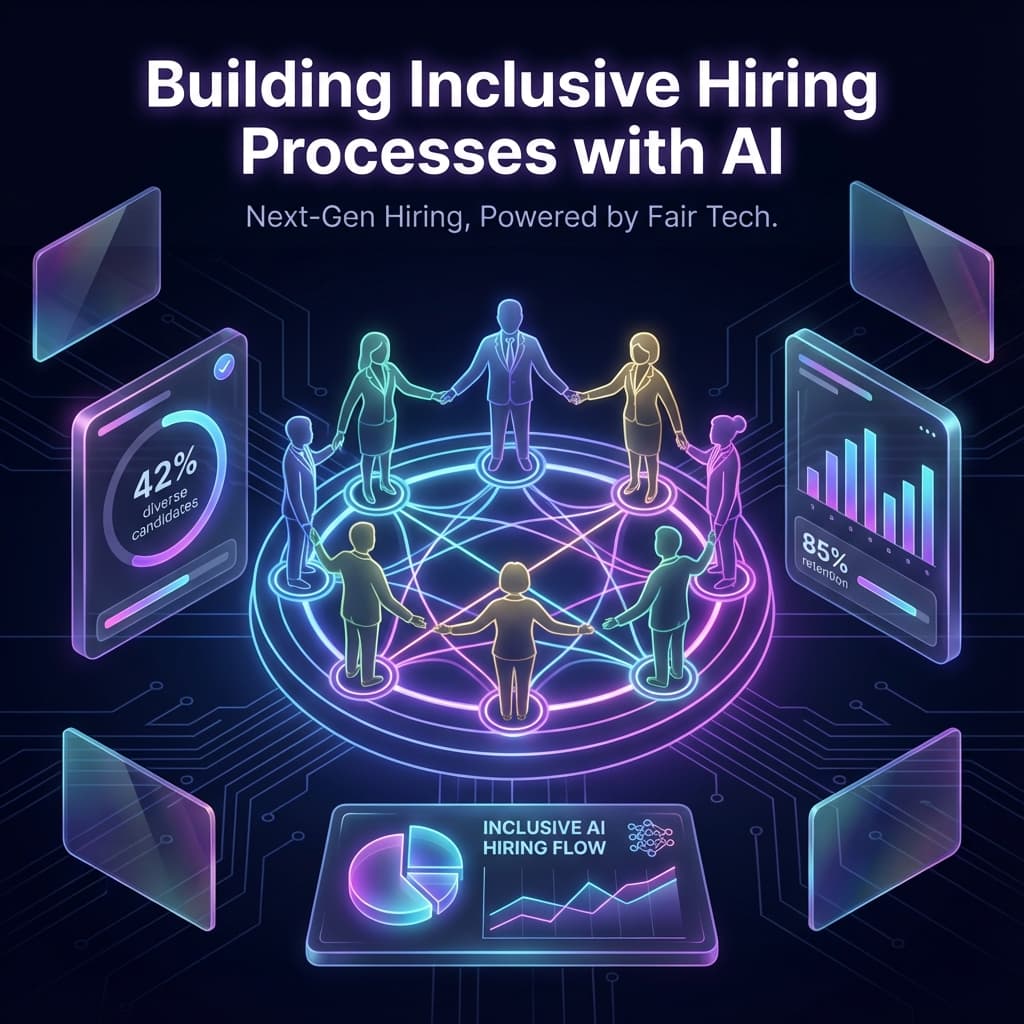
- 42% women in new hires (+24 points)
- 31% underrepresented minorities (+19 points)
- Quality-of-hire scores improved 15%
- Legal risk decreased (0 discrimination complaints)
Cost: $40K investment, $600K+ in avoided mis-hires and legal risks (see our ROI Calculator for sector-specific math)
Common Pitfalls to Avoid
1. Diversity Theater
Showcasing diverse candidates who then face homogeneous interview panels or hostile cultures = high turnover
Fix: Ensure diversity at ALL stages, especially interviewers and leadership
2. Lowering the Bar
Inclusive ≠ unqualified
Fix: Same high standards, broader PATHS to demonstrate qualification
3. Ignoring Intersectionality
Treating "diversity" as a monolith (e.g., white women vs women of color face different barriers)
Fix: Granular data collection, tailored strategies per group
4. Set-and-Forget AI
Deploying AI without ongoing monitoring → hidden bias can emerge
Fix: Quarterly audits, continuous training data refresh
Actionable 30-Day Checklist
Week 1:
- Audit current diversity metrics
- Review 10 recent job descriptions for bias
- Calculate pass-through rates by stage
Week 2:
- Rewrite 2-3 job descriptions with inclusive language
- Add 3 diversity-focused sourcing channels
- Train hiring managers on structured interviews
Week 3:
- Pilot blind resume review for 1 role
- Implement AI screening tool (ARIA demo)
- Create standardized scorecards
Week 4:
- Compare pilot results vs traditional process
- Survey candidate experience
- Set quarterly diversity goals
Conclusion
Inclusive hiring isn't charity—it's competitive advantage. Diverse teams innovate faster, understand customers better, and make smarter decisions.
AI removes human bias patterns when implemented ethically. The framework above provides a roadmap from aspiration to action.
Ready to build a more inclusive pipeline?
Try ARIA's AI interview platform free — or see how we compare to HireVue and other alternatives first.
Start free → (7 days or 10 interviews)