Introduction: The Voice AI Revolution in Recruiting
The recruitment landscape is undergoing a seismic shift. Traditional phone screens that once consumed hours of recruiter time are being transformed by Voice AI technology. In 2026, 99% of Fortune 500 companies use AI in their recruitment processes (AllAboutAI/SHRM), and over 80% of enterprises are expected to use AI for significant parts of their hiring workflow (TechRSeries). Voice AI—the next evolution beyond chatbots and resume screeners—is rapidly becoming the new frontier.
Voice AI in hiring isn't science fiction—it's today's reality. This comprehensive guide explores how this technology works, why it matters, and how your organization can leverage it to stay competitive.
What is Voice AI in Recruitment?
Voice AI hiring platforms use advanced natural language processing (NLP) and machine learning to conduct conversational interviews with candidates. Unlike rigid chatbots, modern Voice AI systems:
- Hold natural, human-like conversations
- Adapt questions based on candidate responses
- Score answers against a job-specific rubric and measure response patterns (speaking pace, response time)
- Provide real-time insights to hiring teams
- Interview in Spanish and English with native-quality voices
Key Technologies Powering Voice AI:
- Speech Recognition: Converts candidate speech to text with high accuracy using current speech-recognition models
- Natural Language Understanding: Comprehends context, intent, and nuance
- Response-Pattern Analysis: Measures speaking pace and response time — no emotion inference
- Machine Learning: Improves interview quality over time based on outcomes
The Business Case: Why Voice AI Matters
1. Unprecedented Scalability
Traditional recruiting methods hit a ceiling. A human recruiter can realistically conduct 5-8 phone screens per day. Voice AI agents conduct unlimited simultaneous interviews—scaling from 10 to 10,000 candidates without additional headcount.
Real-World Impact:
- A Fortune 100 staffing partner reported that 90% of AI-screened candidates advanced to first round, compared with roughly 50% under human screeners (a16z, 2025)
- Staffing agencies are doubling throughput with 24/7 AI scheduling and consistent scoring
- Global companies run continuous interview operations across all time zones without adding headcount
2. Dramatic Cost Reduction
The average cost-per-hire in the U.S. is approximately $4,700–$4,800 (SHRM, 2023–2026 benchmarks), and can exceed $10,000 for specialized roles. Companies using AI in recruitment report a 30% reduction in cost-per-hire and 25% faster time-to-hire on average (AllAboutAI, 2026).
Voice AI drives these savings by:
- Eliminating recruiter time spent on screening calls
- Reducing time-to-hire significantly—AI cuts it by an average of 25%, with some companies reporting a drop from 27 days to just 7 days (AllAboutAI, 2026)
- Decreasing candidate drop-off rates (instant scheduling vs weeks of back-and-forth)
- Lowering bad hire costs through better qualification
3. Improved Candidate Experience
Contrary to concerns about "robotic" interactions, candidates increasingly embrace Voice AI interviews:
- Higher candidate satisfaction through instant scheduling and 24/7 availability
- Schedule interviews at their convenience, reducing stress and scheduling conflicts
- Reduced anxiety from standardized, bias-free evaluation processes
- Instant feedback and next steps
4. Data-Driven Decision Making
Voice AI transforms gut-feel hiring into science:
- Objective Scoring: Standardized evaluation criteria across all candidates
- Predictive Analytics: Correlation between interview performance and job success
- Bias Reduction: Blind evaluation based on skills, not demographics
- Continuous Improvement: Machine learning refines assessment accuracy over time
According to recent industry research, 93% of recruiters plan to increase AI usage in 2026 (DemandSage), and by year-end, roughly 80% of enterprises will use AI across their hiring workflows (TechRSeries).
How Voice AI Interviews Actually Work
Let's demystify the technology with a step-by-step walkthrough:
Step 1: Job Profile Creation
Hiring managers define role requirements, must-have skills, and evaluation criteria. The AI builds a custom interview script and scoring rubric.
Step 2: Candidate Invitation
Candidates receive an email or SMS with a unique interview link. They click to start—no apps to download, no complex setup.
Step 3: The Interview
The Voice AI agent introduces itself, explains the process, and begins asking questions. The conversation flows naturally with follow-up questions based on responses.
Example exchange:
AI: "Tell me about a time you handled a difficult customer situation."
Candidate: "At my last role in retail, a customer was upset about a delayed shipment..."
AI: "That sounds challenging. How did you communicate with the customer to manage their expectations?"
Step 4: Analysis & Scoring
While the interview happens, AI evaluates:
- Content quality (relevance, depth of answers)
- Communication skills (clarity, articulation)
- Response patterns (speaking pace, response time)
- Behavioral indicators (problem-solving approach)
Step 5: Report Generation
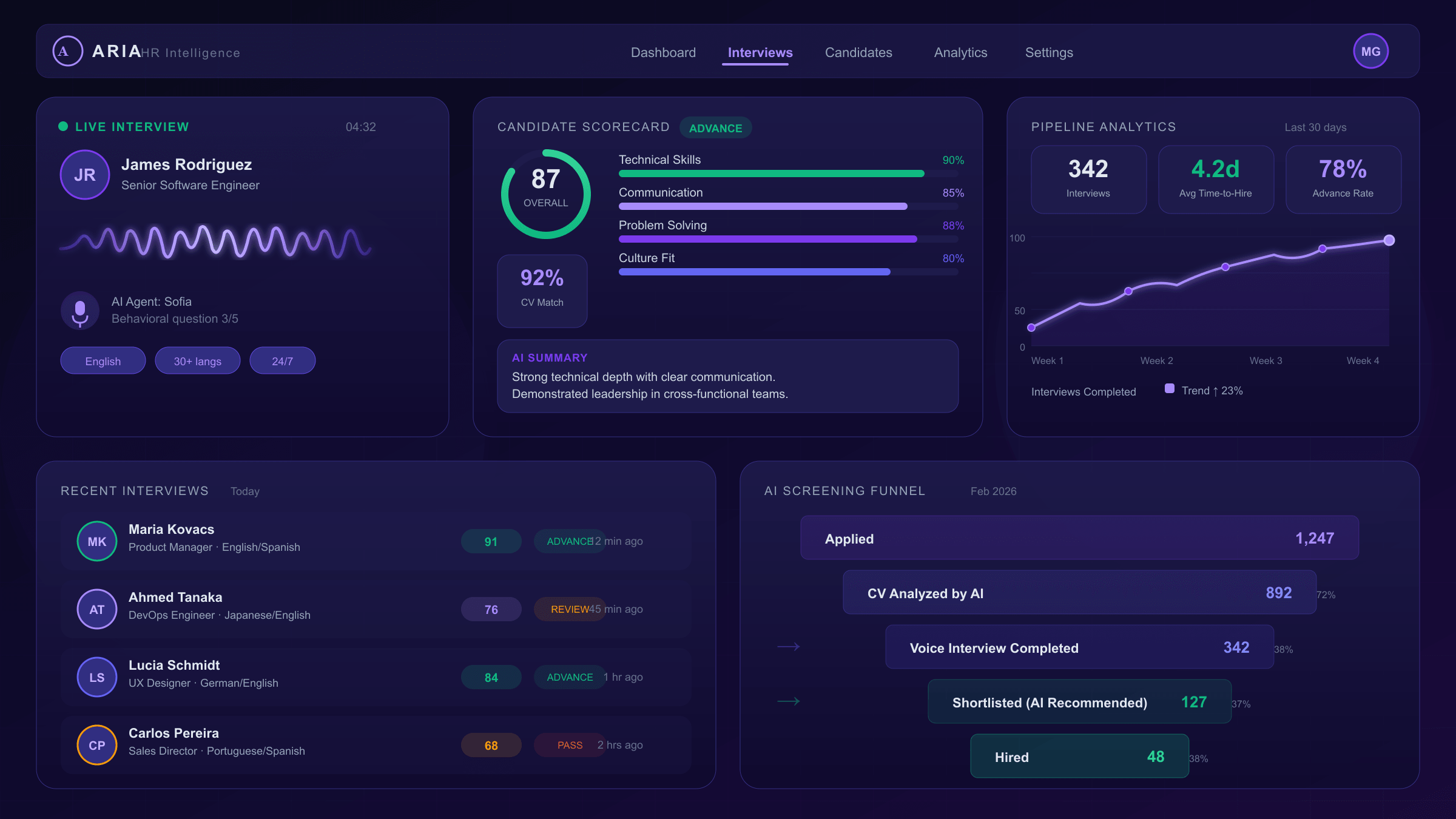
Within minutes, hiring managers receive:
- Overall candidate score with breakdown by criteria
- Transcript with highlighted key moments
- AI-generated summary of strengths/concerns
- Recommendation (Advance, Maybe, Pass)
Industry Use Cases
Enterprise Hiring Teams
Challenge: High-volume hiring for customer service, sales, tech roles Solution: AI screens thousands of applicants, surfacing top candidates to human recruiters Result: Companies report 25–30% reduction in cost-per-hire and significantly faster shortlisting (SHRM/AllAboutAI)
Staffing & BPO Firms
Challenge: Serve multiple clients with varying requirements simultaneously Solution: Multi-tenant AI platform with client-specific interview flows and white-label branding Result: A Fortune 100 staffing partner saw 90% of AI-screened candidates advance vs ~50% with human screeners, effectively doubling throughput (a16z)
Executive Search
Challenge: Assess soft skills for senior roles across time zones Solution: AI conducts structured behavioral interviews in Spanish and English Result: More thorough, consistent vetting in less time—enabling firms to evaluate global candidates without scheduling constraints
The Technology Roadmap: 2026-2028
Current State (2026)
- Spanish and English interviews
- Integration with major ATS platforms
- Response-pattern analysis (speaking pace, response time)
- Customizable interview scripts
The conversational AI market is projected to reach $14.29 billion in 2025, expanding at 23.7% CAGR to $41.39 billion by 2030 (Grand View Research). Voice AI agents specifically represent a $2.4 billion market in 2024, projected to reach $47.5 billion by 2034 (Market.us).
Coming Soon (2027)
- Video + Voice Analysis: Combine facial cues with speech for deeper insights
- Predictive Job Matching: AI recommends best roles based on candidate profile
- Continuous Learning: AI improves by analyzing actual job performance outcomes
- Hyper-Personalization: Interviews adapt in real-time to candidate seniority/background
Future Vision (2028+)
- Virtual Reality Interviews: Immersive scenario-based assessments
- Emotion AI: Advanced emotional intelligence evaluation
- Global Talent Pools: Instant cross-border hiring with AI handling language and cultural nuances
- Autonomous Hiring Workflows: End-to-end recruitment with minimal human intervention
Addressing Common Concerns
"Won't AI replace human recruiters?"
No—AI augments, not replaces.
Voice AI handles repetitive screening. Human recruiters focus on high-value activities:
- Building candidate relationships
- Selling the company vision
- Making final hiring decisions
- Strategic workforce planning
The best outcomes come from human + AI collaboration.
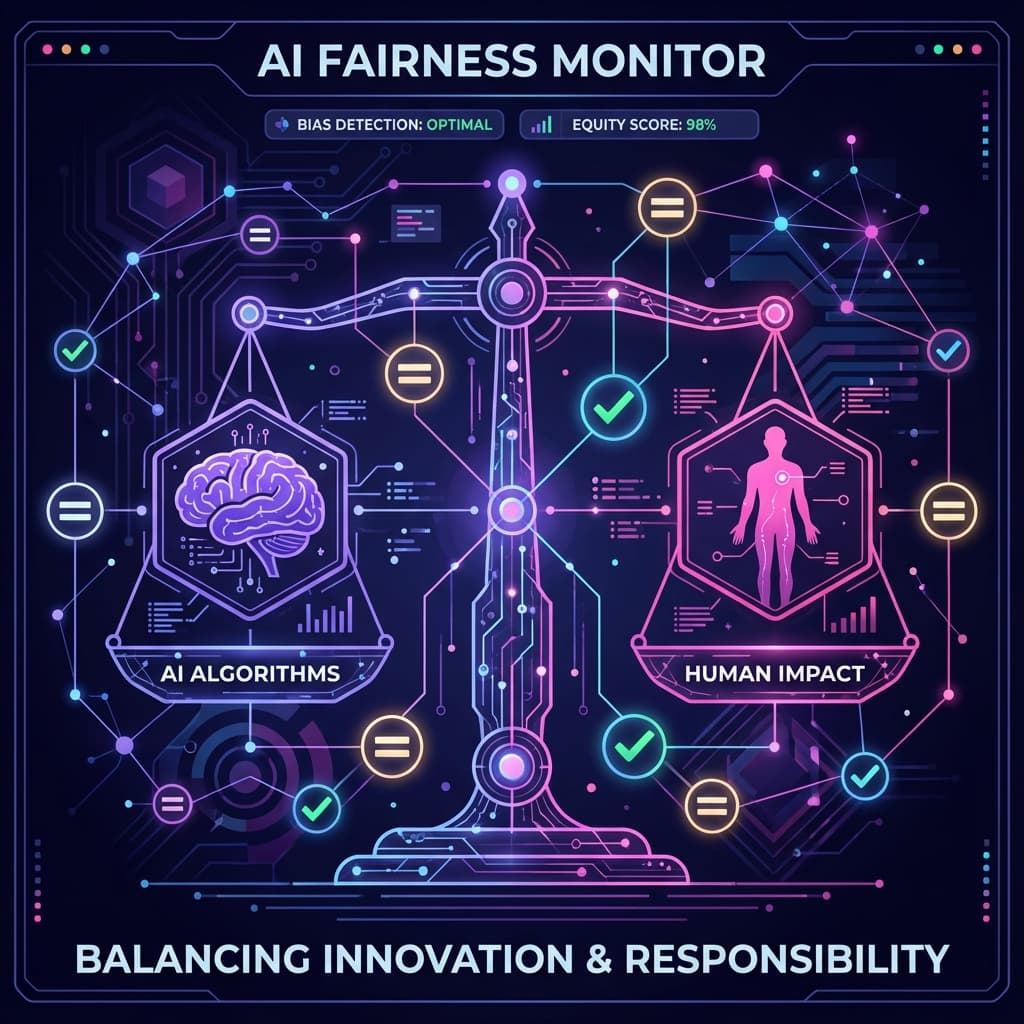
"What about bias and fairness?"
AI done right reduces bias compared to humans (we cover this in depth in AI vs Human Recruiters: The Truth About Bias in Hiring):
- Evaluates all candidates with identical criteria
- Ignores age, gender, accent (unless job-relevant)
- Provides audit trails for EEOC compliance
- Requires careful design to avoid algorithmic bias
ARIA's approach to fairness:
- Standardized evaluation criteria applied equally to every candidate
- Transparent scoring—hiring managers can see exactly why scores were assigned
- Human oversight built into the workflow—AI recommends, humans decide
- Designed with GDPR compliance and EU AI Act safeguards and global data protection standards in mind
"Do candidates really accept AI interviews?"
Adoption data speaks clearly:
- 79% of Gen Z have used AI tools in their job search, and 93% of Gen Z knowledge workers use two or more AI tools weekly (Gallup/Walton Foundation, 2025; Google survey, 2025)
- Higher completion rates compared to traditional scheduling—candidates interview at their convenience, reducing drop-offs
- Candidates report reduced anxiety from standardized, bias-free evaluation processes
The key: transparency. Tell candidates upfront they're speaking with AI.
Implementation Best Practices
1. Start With High-Volume Roles
Don't boil the ocean. Begin with:
- Customer service
- Sales development reps
- Entry-level tech positions
These roles have:
- Clear evaluation criteria
- High application volumes
- Proven success patterns
2. Define Success Metrics
Before launching, establish KPIs:
- Time-to-fill reduction (target: 60%+)
- Cost-per-hire decrease
- Quality-of-hire improvement (measured at 90 days)
- Candidate satisfaction scores
3. Train Your Team
Ensure recruiters understand:
- How to interpret AI-generated reports
- When to override AI recommendations
- How to use insights in final interviews
4. Iterate Based on Data
Voice AI improves with feedback:
- Track which candidates AI advanced vs passed
- Measure their actual job performance
- Feed data back to refine the model
ROI Calculator: Voice AI vs Traditional
Assumptions: 100 hires/year company
| Metric | Traditional | With Voice AI | Impact |
|---|---|---|---|
| Screening Hours/Year | 2,000 hrs | ~500 hrs | 75% reduction |
| Cost Impact | $4,700/hire | ~$3,300/hire | ~30% savings (industry avg) |
| Time-to-Hire | 27-45 days | 7-15 days | Up to 74% faster |
| Screening Quality | ~50% advance | ~90% advance | Better candidate throughput |
Figures based on SHRM cost-per-hire benchmarks, AllAboutAI industry averages, and a16z staffing case study data. Individual results vary by company size, industry, and implementation.
ROI typically achieved in 3-6 months. For a full breakdown by company size, see our ROI Calculator: AI Interviews vs Traditional Recruiting Costs.
Getting Started: Your 30-Day Roadmap
Week 1: Assessment
- Audit current hiring process
- Identify highest-pain roles
- Define success metrics
Week 2: Platform Selection
- Evaluate Voice AI vendors (ARIA, HireVue alternatives, and others)
- Check ATS integration capabilities (seamless applicant tracking system connectivity)
- Request demos with your actual job descriptions
Week 3: Pilot Program
- Launch with 1-2 job requisitions
- Train 2-3 recruiters as champions
- Set up feedback loops
Week 4: Evaluate & Scale
- Review metrics vs benchmarks
- Gather team + candidate feedback
- Plan rollout to additional roles
Sources & References
- SHRM Human Capital Benchmarking Report (2023) — Average cost-per-hire: $4,700
- AllAboutAI, "AI Recruitment Statistics 2026" — 99% Fortune 500 AI adoption, 30% cost-per-hire reduction
- DemandSage, "AI Recruitment Statistics" (2026) — 93% of recruiters plan to increase AI usage
- Grand View Research — Conversational AI market: $14.29B (2025) to $41.39B (2030)
- Market.us — Voice AI agents: $2.4B (2024) to $47.5B (2034)
- a16z (2025) — Fortune 100 staffing partner: 90% AI-screened candidates advance rate
- TechRSeries — 80% of enterprises expected to use AI in hiring by 2026
- Gallup/Walton Foundation Survey (2025) — 47% of Gen Z use AI weekly, 79% have used AI tools
- Google Knowledge Worker Survey (2025) — 93% of Gen Z use 2+ AI tools weekly
- Deloitte Global Gen Z & Millennial Survey (2025) — 57% of Gen Z use generative AI at work
- Gartner (2026) — 40% of enterprise apps will integrate task-specific AI agents by year-end
Conclusion: The Competitive Imperative
Voice AI in hiring isn't a "nice-to-have" emerging technology—it's rapidly becoming table stakes. Companies that adopt now gain decisive advantages:
- Speed: Fill roles in days, not months
- Quality: Data-driven candidate selection
- Scale: Grow without proportional recruiting costs
- Experience: Modern, candidate-friendly process
The question isn't whether to adopt Voice AI, but how quickly you can implement it effectively.
Start Your Voice AI Journey
Ready to transform your hiring? ARIA's Voice AI platform is trusted by enterprises, staffing firms, and executive search teams worldwide.
Try ARIA free:
- Free for 7 days or 10 AI interviews
- Full platform access
- Setup in under 10 minutes
Or contact our team to discuss your specific hiring challenges.