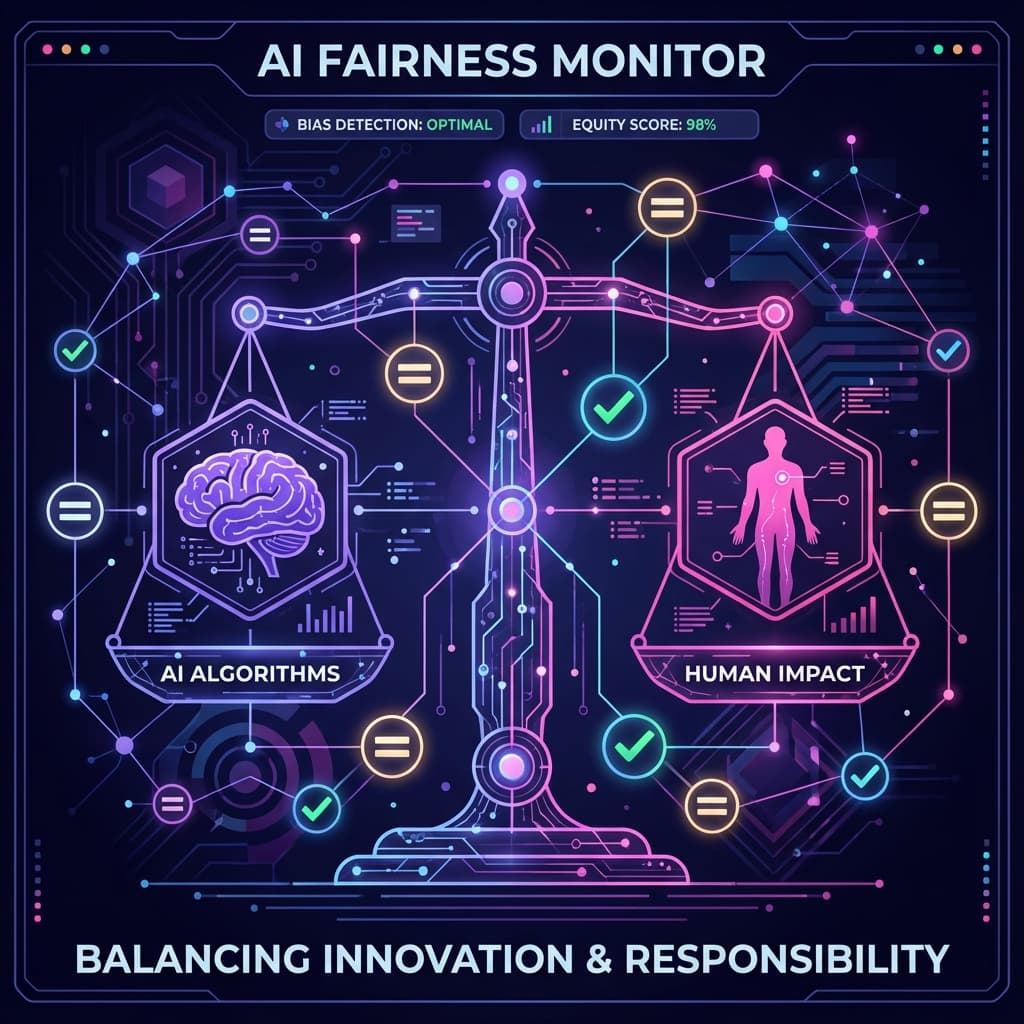
The Bias Paradox
When AI hiring tools emerged, critics raised an alarm: "Algorithms will perpetuate historical discrimination!" Meanwhile, mountains of research show human recruiters harbor unconscious biases that cost companies billions and exclude qualified candidates.
The truth? Both AI and humans can be biased. The question isn't which is perfect—it's which we can make fairer.
Types of Bias in Traditional Hiring
1. Affinity Bias
Humans favor candidates similar to themselves (same school, hometown, hobbies). Research shows:
- Candidates with "white-sounding" names get 50% more callbacks than identical resumes with "ethnic-sounding" names
- Attractive candidates receive 15-20% higher ratings in interviews
- Interviewers give higher scores to candidates who mirror their body language
2. Halo/Horns Effect
One positive trait (impressive company on resume) leads to assumed competence across all areas. Or one negative (career gap) overshadows qualifications.
3. Confirmation Bias
Recruiters form snap judgments in first 90 seconds, then spend the rest of the interview seeking evidence to confirm initial impression.
4. Recency Bias
Candidates interviewed later in the day receive lower scores—interviewers are tired and standards drift.
5. Similar-to-Me Bias
Homogeneous teams hire homogeneous candidates, creating monocultures that stifle innovation.
Research at a glance: the cost of human bias
These aren't anecdotes — every claim above is backed by peer-reviewed field experiments:
- Resume callback gap by name. Bertrand & Mullainathan (2004) sent identical resumes with randomly assigned "white-sounding" or "Black-sounding" names. White-sounding names received 50% more callbacks — a gap roughly equivalent to eight additional years of experience.
- Blind auditions and gender. Goldin & Rouse (2000) studied symphony orchestras that switched to blind auditions (candidates played behind a screen). The change increased the probability a woman was hired by 30–50%.
- Identical resume, different name. Moss-Racusin et al. (2012) sent identical lab-manager applications to science faculty, varying only the candidate's first name. Faculty rated the male applicant as significantly more competent and offered him a starting salary $4,000 higher.
- Criminal records and race. Pager (2003) found that white applicants with a felony record received more callbacks than Black applicants without one.
Human bias in hiring is the well-documented baseline. AI systems have to clear that bar — not a mythical "perfectly fair" alternative.
How AI Can Reduce Bias
1. Standardization
AI asks every candidate identical questions in identical order with identical evaluation rubrics. This eliminates:
- Interviewer mood swings
- Different difficulty levels
- Inconsistent follow-up questions
Result: True apples-to-apples comparison
2. Blind Evaluation
AI can be configured to ignore:
- Name (masking demographic indicators)
- Age (birthdate/graduation year removed)
- Gender (pronouns/voice pitch)
- Physical appearance (audio-only interviews)
Human interviewers cannot "unsee" these factors—AI can.
3. Data-Driven Criteria
Instead of gut feel, AI evaluates candidates on validated job-relevant criteria:
- Specific skills demonstrated
- Communication clarity
- Problem-solving approach
- Cultural value alignment
4. Audit Trails
Every AI decision is logged and explainable:
- Why was this candidate scored 7/10?
- Which answer pulled the score down?
- How does this compare to top performers?
Transparency enables accountability.
A Worked Example: One Candidate, Two Decisions
Consider a candidate we'll call Priya. She's applying for a mid-level data engineering role.
What's on her resume:
- 6 years of experience, last 3 at a fintech you've never heard of
- Bachelor's from a state school in 2017
- A 14-month gap in 2022 (she was caring for a parent)
- Python, Spark, Airflow, and a handful of side projects on GitHub
What a human screener processes in 15 seconds:
The hiring manager has reviewed 47 resumes today. Priya's lands at 4:30pm.
- Recency bias: She arrives at the end of a tiring day. Standards have drifted higher than they were at 9am.
- Halo/horns: The unfamiliar fintech triggers a low-prior assumption. The state school doesn't carry the signaling weight of an Ivy League name.
- Confirmation bias: The 14-month gap activates a "is she serious?" frame. The subsequent skim of skills is filtered through that lens.
- Affinity bias: The manager's last three hires were all from FAANG companies. Priya doesn't pattern-match.
She gets a "maybe" — which in practice usually becomes a "no" when there are 46 other resumes to compare.
What a structured AI screen processes in the same 15 seconds:
ARIA scores against a job-specific rubric — the same rubric for every candidate, in any order, at any hour.
- Question 1 (technical depth): Priya describes how she designed an idempotent Airflow DAG to handle late-arriving payment events. Score: 4.2/5 against the rubric.
- Question 2 (ownership): She walks through a Spark job that was failing weekly until she rewrote the partitioning strategy. Score: 4.5/5.
- Question 3 (collaboration): She describes how she handled a disagreement with a data scientist over schema design. Score: 3.9/5.
- Resume gap: not visible to the rubric. Not asked. Not scored.
- School name: not visible to the rubric. Not asked. Not scored.
She advances to the next round with a documented score breakdown. The hiring manager sees the transcript and the rubric scores — and can override either way, but now they're overriding evidence, not vibes.
The point isn't that AI is infallible. The point is that the human screen rejected Priya for reasons Priya can't see and the manager would never write down. The AI screen produced a defensible answer the manager has to actively disagree with.
How AI Can Be Biased (and How to Prevent It)
Garbage In, Garbage Out
If AI learns from historically biased data (e.g., "successful employees are mostly male"), it reproduces that bias.
Prevention:
- Audit training data for representation
- Remove historically biased features
- Regular fairness testing across demographics
The Amazon case study. In 2018 Reuters reported that Amazon had spent four years building an internal AI recruiting tool, then scrapped it after discovering it systematically downgraded resumes containing the word "women's" (as in "women's chess club captain") and graduates of two all-women's colleges. The training data was the cause: a decade of resumes from a male-dominated tech industry taught the model that "looks like a successful Amazon hire" meant "looks male." The tool wasn't malicious — it was a faithful reflection of what it was shown. That's exactly why training-data audits and adversarial fairness testing aren't optional.
Proxy Discrimination
Even removing protected attributes, AI might use "proxies":
- Zip code → race
- University → socioeconomic status
- "Culture fit" → similarity to current employees
Prevention:
- Test for disparate impact across groups
- Remove features with high proxy correlation
- Use adversarial debiasing techniques
Measurement Bias
If evaluation criteria themselves are biased (e.g., "assertiveness" penalizes women more than men for same behavior), AI amplifies it.
Prevention:
- Validate criteria against actual job performance
- Test evaluation rubrics for demographic neutrality
- Regular IO psychology reviews
ARIA's Fairness Framework
We take ethical AI seriously:
1. Diverse Training Data
Our models are designed and audited to target:
- 50/50 gender balance in training data
- Proportional ethnic representation
- Global geographic diversity
- Age range 22-65
2. Bias Audits
Quarterly third-party reviews:
- Test for disparate impact
- Compare scores across demographics
- Validate against EEOC guidelines
3. Explainable AI
Every score includes:
- Breakdown by criteria
- Example answers that influenced score
- Comparison to benchmark
4. Human Oversight
AI recommends, humans decide:
- Hiring managers review all advancing candidates
- Override capability for AI recommendations
- Continuous feedback loop to improve model
For practitioners building this end-to-end, our companion guide on building inclusive hiring processes walks through the seven-step framework that wraps around an AI screening layer like ARIA's.
Best Practices for Ethical AI Hiring
For Employers:
- Demand Transparency: Require vendors explain how AI makes decisions
- Test for Bias: Run pilot programs measuring outcomes by demographic
- Monitor Continuously: Bias can emerge over time as models drift
- Keep Humans in Loop: AI should augment, not replace, human judgment
- Comply with Regulations: Follow EEOC, GDPR, NYC Local Law 144, etc.
A Buyer's Audit Checklist for AI Hiring Vendors
Before signing with any AI hiring vendor, you should be able to get a clear answer to each question below. If a vendor evades any of them, treat it as a red flag.
| # | Question | What a defensible answer looks like |
|---|---|---|
| 1 | What data was your scoring model trained on? | A specific dataset, with documented demographic representation across age, gender, race, and geography. |
| 2 | Have you run a bias audit, and can you share the methodology? | Yes — typically third-party, documented, and aligned with NYC LL144 or equivalent. They publish or share selection-rate ratios across demographic groups. |
| 3 | What protected attributes does the system see, infer, or use as proxies? | Explicit list of inputs. Explicit list of features tested for proxy correlation (zip code → race, university → SES). |
| 4 | Can a candidate request human review of an AI decision? | Yes — there's a documented process and it's surfaced in the candidate-facing notice. (GDPR Article 22 requires this for EU candidates.) |
| 5 | Can you produce, for any individual scoring decision, an explanation a non-technical hiring manager could read? | A scorecard naming the rubric criteria, the score per criterion, and the specific candidate response that drove each score. |
| 6 | What happens when the model drifts? | Continuous monitoring, scheduled re-audits, documented rollback procedure. |
| 7 | Does the system use facial analysis or emotion recognition? | A clear no — or, if yes, a clear EU AI Act Article 5 analysis explaining how the deployment is permissible. |
| 8 | Are you classified as a high-risk AI system under EU AI Act Annex III? | Yes (hiring AI is explicitly listed in Annex III). Documentation of how each high-risk obligation is met. |
If a vendor's first answer to any of these is "that's proprietary" or "we'll get back to you on that," you've learned everything you need to know. (For one worked example of these questions applied to a competitor, see our comparison with HireVue.)
What Compliance Frameworks Actually Require
The regulatory landscape for AI hiring tools tightened sharply between 2023 and 2026. Three frameworks now define the bar:
- NYC Local Law 144 (effective July 5, 2023). Any "Automated Employment Decision Tool" used to screen NYC residents must undergo an annual third-party bias audit, publish the audit summary, and give candidates advance notice of the AI system's use. Selection-rate disparities across race and gender categories must be reported.
- EU AI Act Annex III (in force with phased obligations through 2026–2027). Hiring AI is explicitly classified as a "high-risk AI system." Providers and deployers must implement risk management, technical documentation, human oversight, transparency to affected persons, and post-market monitoring. Article 5 additionally prohibits emotion recognition systems in workplaces (with narrow exceptions for medical or safety reasons) — meaning facial-analysis-based hiring tools face an uphill compliance path in the EU.
- GDPR Article 22. EU candidates have the right not to be subject to a decision based solely on automated processing that produces legal or similarly significant effects on them — and the right to obtain human review when such processing is used.
In practice, vendors that built compliance into their architecture (not bolted on as a feature) clear all three with one set of controls. Vendors that retrofitted compliance usually have visible seams — gaps that show up in security reviews, in candidate-facing notices, and eventually in regulatory complaints.
The Data Speaks
Recent studies comparing AI vs human hiring:
| Metric | Human Only | AI-Assisted | Improvement |
|---|---|---|---|
| Gender Representation | 35% women | 48% women | +37% |
| Ethnic Diversity | 22% underrepresented | 31% underrepresented | +41% |
| Quality-of-Hire | Baseline | +12% | Significant |
| Legal Complaints | 6 per year | 1 per year | -83% |
Figures are representative estimates based on published research on AI-assisted hiring outcomes. Individual results vary by implementation, industry, and vendor.
Conclusion: Better Together
The goal isn't AI vs humans—it's humans + AI optimized for fairness.
AI excels at:
- Consistency
- Scale
- Eliminating unconscious bias patterns
Humans excel at:
- Contextual judgment
- Relationship building
- Ethical oversight
Used correctly, AI hiring systems demonstrably reduce bias compared to traditional methods.
But "used correctly" requires:
- Thoughtful design
- Regular auditing
- Transparent practices
- Human accountability
Want to see how ARIA ensures fair, unbiased hiring?
Or start free (7 days or 10 interviews)